Corrections and additions to
Epler's 2010 "Water Beetles of Florida"
(last update 5 December 2025)
Scirtidae
The taxonomy of the North American
Scirtidae has been revised by Gimmel, M.L. & Epler, J.H.
2024. Catalog of the Scirtidae of America north of Mexico
(Coleoptera: Scirtoidea), with taxonomic and distributional
notes. The Coleopterists Bulletin 78: 319-334; paper is
available on my publications page.
6-ix-2024
Gyrinidae
I have been too slow in getting out
a corrected version of page 7.7 in the Gyrinidae chapter.
The updated version now includes Dineutus
shorti in the key, and notes
concerning the species in Florida. This species was
described in 2015, and I added it to the checklist for Florida,
but I've been unable to get to it until recently. Click here for the updated pages.
3-ix-2024
Dytiscidae
The
taxonomy of the tribe Hygrotini has been updated. Miller &
Bergsten (2016) had reinstated Coelambus
as a full genus and included Hygrotus
berneri Young & Wolfe and H. nubilus (LeConte) in
it. But more recent work by Villastrigo et al. (2017) has
established new genera and subgenera within the tribe.
Thus, in Florida, we now have Clemnius
(Clemnius) berneri (Young & Wolfe), Clemnius (Cyclopius) marginipennis
(Blatchley) and Hygrotus
(Leptolambis) nubilus (Le Conte).
See:Villastrigo, A, Ribera, I., Manuel, M., Millan, A. &
Fery, H. 2017. A new classification of the tribe Hygrotini
Portevin, 1929 (Coleoptera: Dytiscidae: Hydroporinae). Zootaxa
7317: 499–529.
5-xii-2025
The
Cybistrinae have been revised and the sole Florida species in
the genus Megadytes
has been moved to the genus Metaxydytes.
Thus we now have Metaxydytes
fraternus (Sharp). See: Miller,
KB, M.C. Michat & N. Ferreira Jr. 2024. Reclassification of
Cybistrinae Sharp, 1880 in the Neotropical Region (Coleoptera,
Adephaga, Dytiscidae), with the description of new taxa. Zookeys
1188: 125-168.
16-vii-2024
Elmidae
Kamite (2016) had synonymized Promoresia with Optioservus. Later,
Kobayashi et al. (2021) synonymized Gonielmis
and Optioservus with Heterlimnius. Thus we
now have three species of Heterlimnius
recorded from Florida: H. dietrichi
(Musgrave), H.
ovalis (LeConte) and H.
tardellus (Fall). See: Kamite,
Y. 2016. Revision of the genus Optioservus
Sanderson, 1953, part 3: The O. elegans species
group. Koleopterologische Rundschau 86: 205-212, and
Kobayashi, T., Hayashi, M., Kamite, Y. & Sota, T. 2021.
Molecular phylogeny of Elmidae (Coleoptera: Byrrhoidea) with a
focus on Japanese species: implications for intrafamilial
classification. Systematic Entomology 46: 870–886.
5-xii-2025
Two recent publications necessitate
updating the species list for Florida once again.
Miller, K.B. 2005. Revision of the New World and south-east
Asian Vatellini (Coleoptera: Dytiscidae: Hydroporinae) and
phylogenetic analysis of the tribe. Zool. J. Linnean Soc. 144:
415-510. This paper reinstates Derovatellus floridanus as a full
species.
Bergsten, J. & K.B. Miller. 2005. Taxonomic revision
of the Holarctic diving beetle genus Acilius Leach (Coleoptera: Dytiscidae). Sys.
Ent. 31: 145-197. One new species, A. confusus Bergsten, is
described from the northeast US; it was recorded from as far
south as South Carolina. I have a male and female of this
species from Little Dry Creek in Jackson County.
13-iii-2006
p. 12.47-12.48 - Hydrophilus
ensifer reported for Florida.
See: Pintar, M.R. & Keller, J.L. 2020. First
record of Hydrophilus ensifer Brullé (Coleoptera:
Hydrophilidae) in the continental United States. The Coleopterists Bulletin
74: 696-698.
28-xii-2020
5.116 - Uvarus
sp. 1 has been described as Uvarus
sinofelihelianthus Epler. See Epler, J.H. 2020. A
new species of Uvarus Guignot, 1939 (Coleoptera: Dytiscidae: Hydroporinae:
Bidessini) from Florida, USA. Insecta Mundi 0752:
1-4.
28-ii-2020
p. 12.40 - Helocombus
is now considered to be part of Cymbiodyta.
See Toussaint, E.F.A. & Short, A.E.Z. 2019. Historical
biogeography of Holarctic Cymbiodyta water scavenger
beetles in the times of Cenozoic land bridge dispersal routes.
Insect Systematics and Diversity 3: 1-7.
13-i-2020
p. 16.17 - Prionocyphon
limbatus LeConte has been collected from
FL. Three specimens were collected at Tall Timbers
Research Station in Leon Co. in 1993 (material from FSCA)
p. 12.42 - Hydrobius
tumidus is now Limnohydrobius tumidus
(LeConte). See Short, A.E.Z., Cole, J. & Toussaint,
E.F.A. 2017. Phylogeny, classification and evolution of
the water scavenger beetle tribe Hydrobiusini inferred from
morphology and molecules (Coleoptera: Hydrophilidae). Systematic
Entomology 42: 677-691. Of the other two species of Hydrobius
mentioned on p. 12.42 of my FL water beetle manual, melaenus
(Germar) is also now placed in Limnohydrobius; H.
fuscipes (L.) remains in Hydrobius.
17-x-2017
p. 5.111 - The species formerly known as Rhantus calidus (Fabricius) is
now placed in the new genus Meridiorhantus.
Thus it is now known as Meridiorhantus
calidus (Fabricius). See Balke, M, Hájek, J &
Hendrich, L. 2017. Generic reclassification of
species formerly included in RhantusDejean (Coleoptera,
Dytiscidae, Colymbetinae). Zootaxa 4258: 91-100.
12-v-2017
p. 13.11 - Pronoterus
has been synonymized with Suphisellus.
See Baca, S.M, Toussaint, E.F.A., Miller, K.B. & Short,
A.E.Z. 2017. Molecular phylogeny of the aquatic
beetle family Noteridae (Coleoptera: Adephaga) with an emphasis
on data partitioning strategies. Molecular Phylogenetics
and Evolution 107: 282-292. Thus our single
species of this former genus is now Suphisellus
semipunctatus (LeConte).
10-iii-2017
pp. 6.6.15, 6.17 - Promoresia
has been synonymized with Optioservus.
See Kamite, Y. 2016.
Revision of the genus Optioservus Sanderson, 1953,
part 3: The O. elegans species group.
Koleopterologische Rundschau 86: 205-212. Thus we now
have two species of Optioservus recorded from
Florida: O. ovalis (LeConte) and O. tardellus
(Fall).
27-xii-2016
pp. 11.1-11.9 - The species of Hydrochus have been reviewed for
Mississippi (Worthington, R.J., Hellman, J.L. & Lago,
P.K. 2016. Hydrochidae (Coleoptera) of
Mississippi. Transactions of the American Entomological
Society 142: 167-213. As a result, several of my
letter-designated taxa now have "real" names. H.
sp 1 = H. falsus Hellman; H. sp. 2 = H.
jiawanae Makhan; H. sp. 5 = H. pajnii
Makhan; H. sp. 6 = H. schereri Makhan; H.
sp. 8 = H. jaechi Makhan.
23-xii-2016
pp. 5.61; 5.110 - Prodaticus
has been reduced to subgeneric status within Hydaticus. Thus our
most common species is now Hydaticus (Prodaticus)
bimarginatus. See Miller &
Bergsten. 2016. Diving Beetles of the
World. Systematics and Biology of the Dytiscidae.
Johns Hopkins University Press. 320 pp.
10-xi-2016
p. 5.73-5.74 - CoelambusThomsonhas been reinstated as a full genus.
Thus two species previously placed in Hygrotus
are now in Coelambus: C. berneri (Young
& Wolfe) and C. nubilus (LeConte).
Note also that "nubilus" was misspelled in the
manual. See Miller, K.B. & Bergsten, J.
2016. Diving Beetles of the World. Systematics and
Biology of the Dytiscidae. Johns Hopkins University
Press. 320 pp.
6-xi-2016
p. 1.16 - There's a typo in the first part
of couplet 14 leading to Ptilodactylidae. The last phrase
should read "antennal segments 1 and 2 long, 3 very
short". Thanks to Doug Strom for informing me of my lack
of typing skills!
p. 5.78 - The genus Laccomimus
has been established by Toledo & Michat. This genus
replaces Laccodytes Régimbart for the single species
known from Florida, now known as Laccomimus pumilio
(LeConte). See Toledo, M. & Michat, M. 2015.
Description of Laccomimus gen. n. and eleven new species
from the Neotropical region (Coleoptera, Dytiscidae,
Laccophilinae). Zootaxa 3990: 301-354.
30-vii-2015
pp. 12.8; 12.16, 12.17 - Crenitulus
has been considered a synonym of Anacaena for some
time, but was recently reinstated as a full genus by Fikáček
& Vondráček (2014). Thus Anacaena suturalis (LeConte) becomes Crenitulus
suturalis (LeConte). Anacaena limbata remains
the same, and is still unknown from Florida. For more
information and a corrected key separating the larvae of Anacaena,
Crenitulus and Paracymusdownload
this addendum.
9-iii-2015
pp. 16.6-16.13 - Most species of Cyphon
from Florida are now placed in Contacyphon.
See Zwick, P., Klausnitzer, B. & Ruta, R. 2013. Contacyphon Gozis, 1886
removed from synonymy (Coleoptera: Scirtidae) to accommodate
species so far combined with the invalid name, Cyphon Paykull, 1799.
Entomologische Blätter und Coleoptera 109: 337-353. Note
also that species from the "Cyphoncollaris complex" (none
known to date from Florida) are now placed in the genus Nyholmia. See
Klausnitzer, B. 2013. Monophyletische Artengruppe der
ehemaligen Gattung Cyphon
Paykull, 1799 und Beschreibung von neuen Gattungen (Coleoptera,
Scirtidae). Entomologische Nachrichten und Berichte 57:
255-262.
8-i-2014
pp. 12.6, 12.30 - On p. 12.6 in the key for
larval hydrophilids, the third statement in couplet 12 leading
to Enochrus should read "LEFT mandible with one inner
tooth, RIGHT with two inner teeth". The figures
are oriented correctly. In the diagnosis for larvae on p.
12.30, the same mistake was repeated. It is the right
mandible that bears two inner teeth; the left mandible bears one
inner tooth. I wonder why it took so long to find this boo-boo??
27-v-2013
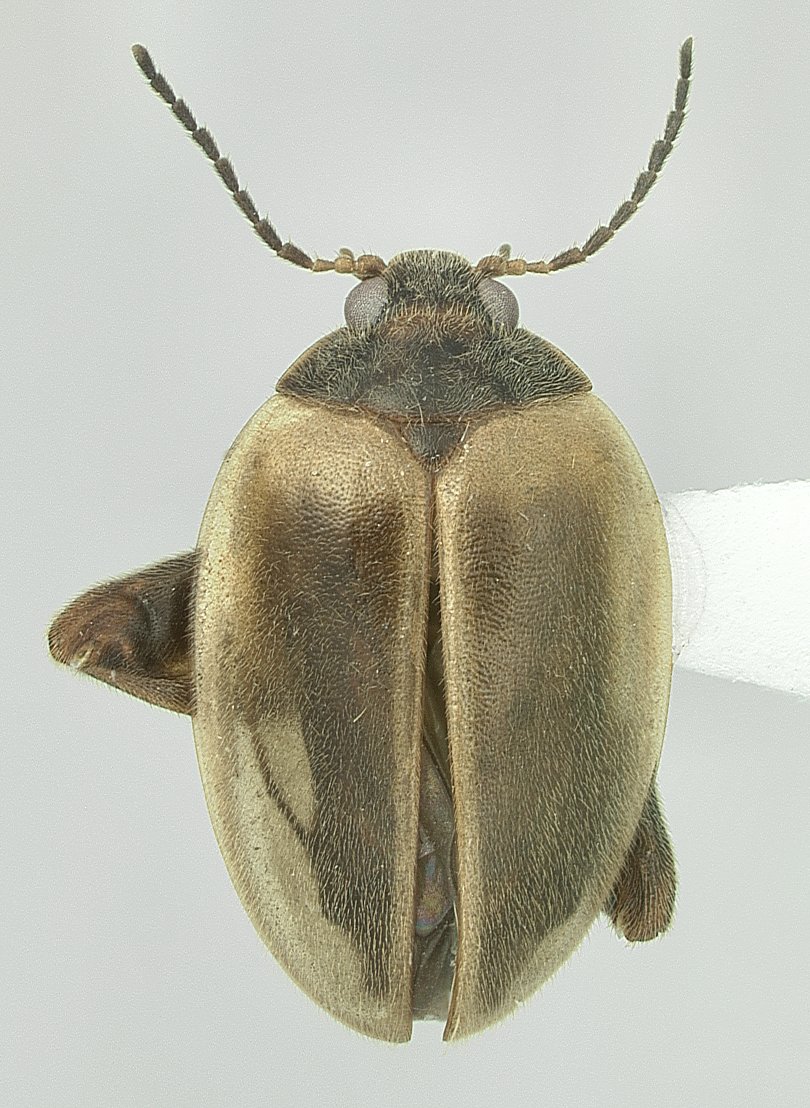
p. 16.52 - Ora discoidea
Champion has been found in Florida (Collier Co.,
Immokalee); it will key to O. texanabut is marked differently.
It can be either mostly tan above or have mostly dark
elytra with a wide pale border, as in the Florida specimen here.
Thanks to Mike Thomas (FSCA) for the photo!
28-xii-2012
pp. 16.22-16.23 - Scirtes
goliai Epler described, replaces Scirtes sp. 1. See
Epler, J.H. 2012. A new species of Scirtes (Coleoptera:
Scirtidae) from southern Florida and the Caribbean.
Zootaxa 3530: 77-82.
pp. 5.38, 18.2, 18.7 - parentheses removed from
author name for Celina
grossula - should be Celina grossula LeConte. I had
followed an error in Young (1979) by placing "LeConte" in
parentheses. Because LeConte originally described the species grossula in the genus Celina, there are no
parentheses around his name.20-x-2012
pp. 3.1, 3.7 - To reiterate about the spelling of
the name of the weevil Auleutes,
it's Auleutes,
not Aleutes or Auletes.
27-vi-2012
p. 5.38, 5.39, 5.41 - Celina
slossonae changed back to its original spelling - call
it Celina slossoni ...
again. Note that even though Mutchler misspelled it as "slossoni" (which is
incorrect; because the species was named for a woman, it should
have been "slossonae"),
Article 33.4 of the ICZN states that such a change is to be
termed an "incorrect subsequent spelling". 14-iv-2012
p. 5.92 - the captions for the two beetles are
switched; N. p. pullus
is on the left, N. p.
floridanus on the right! Thanks to Dana Denson
(RCID) for catching this!
6-vii-2011
p. 5.26 - The genus Stictotarsus is not known from Florida.
Because it is recorded from South Carolina and there is thus a
possibility it may occur here, I included the genus, represented
by the widespread taxon S.
griseostriatus (De Geer), in my key to genera of
dytiscid adults (p. 5.26) of Florida.
It has long been known that the taxon is notable for its
variation and is most likely a complex of species, especially in
Europe. Now this taxon has been established as a new genus, Boreonectes (Angus, R.B. 2010. Boreonectes gen. n., a new
genus for the Stictotarsus
griseostriatus (De Geer) group of sibling species
(Coleoptera: Dytiscidae), with additional karyosystematic data
on the group. Comparative Cytogenetics 4: 123-131). Thus,
the species’ name is now Boreonectes
griseostriatus (De Geer). Given the variability
of this taxon, it is most likely that at least one of the
“variants” known from North America actually represents an
undescribed species, so stay tuned.
Also note that some other Nearctic Stictotarsus are now included in Boreonectes. These
are: B. aequinoctialis
(Clark), B. coelamboides
(Fall), B. dolerosus (Leech),
B. expositus (Fall), B. funereus (Crotch), B. panaminti (Fall)
(tentative placement), B.
spenceri (Leech) and B. striatellus (LeConte).
Boreonectes may be
separated from Stictotarsus
by the shining ventral surface of the head behind the
eyes, with only superficial reticulation (closely punctate in Stictotarsus).
27-i-2011
p. 1.6 - 2nd column, under 3., line 15
should read “the bulging, white abdominal venter, ...”
p. 1.8 - Brady Richards (California State University, Chico, CA)
was somehow left off the list of workers who supplied specimens –
sorry, Brady!
pp. 3.1, 3.7 – Auleutes
is misspelled as “Aleutes”.
p. 5.63 - Couplet 1 has H.
deflatus at 3.8 – 4.7mm but the description has it
listed as 4.2-4.7mm; go with 3.8-4.7 mm.
p. 5.70 - species box: delete space in “inexpectatus”
p. 6.23 – what are termed “basolateral” triangles in couplet 14
should be basomesal triangles
p. 16.14 - under Notes – the “fourth form” referred to in
line 1 is not “keyed below”; it should read “discussed below”.